
Naples Airport to become first coastal airport in South with elevated runway, taxiway lighting

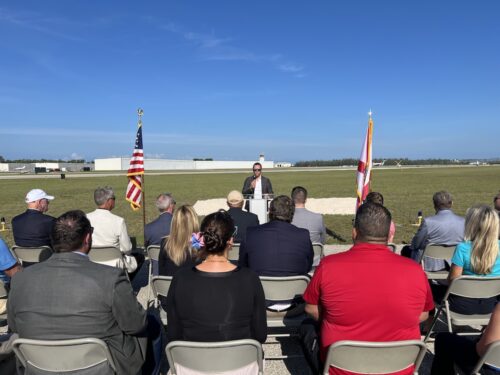
Naples Airport Authority Executive Director Chris Rozansky welcomes guests to an event launching the Airfield Lighting Rehabilitation and Electrical Vault Replacement Project.
Naples Airport has launched a first-of-its-kind project to enhance resiliency and post-storm recovery by elevating its lighting system across the airfield.
The $25.4 million Airfield Lighting Rehabilitation and Electrical Vault Replacement Project will include the installation of 1,080 elevated edge lights along runways and taxiways at Naples Airport. Watertight lights will be positioned 20 inches off the ground to protect against potential storm surge flooding. The new lights will be LED, which will be brighter and provide energy savings compared to the airfield’s current incandescent lights.
Additionally, Naples Airport will reconstruct its electrical vault with a storm-resilient design, which includes raising equipment above the base flood elevation and five feet higher than currently situated.
“After a natural disaster, Naples Airport serves as a base for rescue operations and humanitarian missions, so it’s imperative that the airfield reopens as quickly as possible after a hurricane or tropical storm.” said Chris Rozansky, executive director of the Naples Airport Authority. “An elevated lighting system will help keep the airport operational during a period when the community needs immediate access to critical resources like food, water and relief supplies.”
Aviation, government and community leaders joined project partners for a May 8 ceremony that kickstarted the initiative. Once complete, Naples Airport will be the first coastal airport in the South to elevate its lighting through a resiliency initiative designed to keep the airfield operational after a flooding event.
Elevating airfield lights is a common practice at northern airports so pilots and air traffic controllers maintain visibility during and after snowstorms. However, lights at many airports in the South are mounted flush to the ground or just above ground level, potentially putting them at risk during a flood. The Naples Airport Authority worked closely with the FAA to advocate for this practical design change for flood-prone airports. As a result, the FAA intends to update its national design standards.
“Airports do a lot of lighting rehabilitation work, but it’s not often that an airport gets to redo the entire airfield,” said Sandeep Singh, president and CEO of AVCON, an Orlando-based company that provides planning, engineering and construction management needs for airports. “Every inch matters when water is coming up.”
During Hurricane Ian in 2022, portions of Naples Airport were inundated with storm surge, destroying airfield lighting and navigational aids. Storm surge came within inches of flooding the airport’s lighting vault, a breach that potentially could have knocked out all lighting systems and prevented nighttime and low-visibility operations for weeks or even months.
The Naples Airport Authority’s Board of Commissioners approved $25.4 million in construction and construction administration services for the Airfield Lighting Rehabilitation and Electrical Vault Replacement Project. Construction funds derive from a combination of insurance proceeds, grants from the Florida Department of Environmental Protection’s Resilient Florida Program, allocations from the FAA’s Infrastructure Investment and Jobs Act (IIJA), Florida Department of Transportation Public Transportation Grant Agreement (PTGA) and capital funds included in the Naples Airport Authority’s annual budget. Naples Airport receives no local taxpayer dollars to fund operations or capital projects.
The airfield lighting project, which was approved in October 2025 and is expected to take 20 months to complete, is Naples Airport’s latest initiative aimed at building resilience. In August 2025, Naples Airport received delivery of its new Tiger Dam flood barrier system, which consists of 3,000 feet of flexible tubing that, when filled with water, forms a strong, airtight harrier. The Tiger Dam system can be deployed within hours to protect buildings, equipment and technology against potential flooding.